Wednesday, May 14, 2008

Eros Plus Massacre エロス+虐殺 (1969)


I've been waiting for a year to see this with English subtitles, and have finally received the chance, but as life would have it, I was only able to see the theatrical cut, which runs about an hour shorter than the director's cut. My plans were to write about this in the cinema blog (surprise! surprise!), but the curtailed length made it obvious that several foggy plot points were probably expounded upon in the longer version. Basically, this is the story of the Amakasu Incident, when Japanese police killed anarchist Sakae Osugi, his lover Noe Ito, and Sakae's child nephew, in the aftermath of the Great Kanto Earthquake. The climate after the quake was one of pure pandemonium, as I've read accounts of Koreans being attacked by Japanese mobs after spurious accusations of poisoning the water supply. The film has nothing to do with the temblor itself, but the events in Osugi's life leading up to his death. It is a frame story: a group of college students envision the life of Osugi and his anarchic friends, while living in their own climate of the 70's economic boom in Japan. It would seem that the students are living in a world where many of the ideas that Osugi was arrested and exiled for have come to fruition, yet in the portions of the story where we flashback to the 1920's, Osugi and his friends know that their ideas are far ahead of anything that could applied on a national level. In their discussions, they speak of rallying for government assistance for peasants in Kyushu, and Osugi talks about his being expelled from school.

The images in this film will stay with me for quite some time; I've never seen such intricate framing and blocking. It is quite amazing that Yoshida was able to create such a high quality film on the usual, low-budget of an Art Theatre Guild production. The world in which Osugi lives is quite subjective, as if everything arranged itself through his mind: there is Christian imagery throughout (a religion he had much interest in) and many oneiric sequences of his imminent murder. As for the title, "Eros" refers to the students, as it seems that is all they are interested in. There is a young woman at an art school, also earning wages as a commercial actress, who is falsely accused of prostitution by a policeman. She seems to be willing to bed any man, as is a playboy friend that she is seen with in the opening scenes of the film. This lothario has a brief encounter with a married woman, who appears to be suffering from some sort of mental illness, all before hanging himself in the most cinematic way possible at the film's conclusion. There is also another young student who accompanies the actress, reciting poetry as he observes things, while remaining coy in his advances at her. The students and their compatriots all suffer an existential malady, similar to the problems characters faced in Terayama Shuji's Throw Away Your Books, Rally in the Streets.

"Massacre" refers to Osugi's life, one which the audience knows will end in violence. In one of my favorite scenes, where one of Osugi's lovers is threatening to stab him, he tells her that he accepts death if she is willing to dispense it. It seems that Osugi is wrapped around three women: his wife, Yasuko, who is mentioned but never seen; Itsuko, a journalist who is supporting him and his wife as he cannot find work after being branded as an anarchist, and Noe Ito, another anarchist whom he has become enmeshed with. The film's longest sequence involves Itsuko's attempt to take Osugi's life, and Noe Ito's attempt to stop it. The menage-a-trois struggle against each other for what seems like an hour, each party bringing into play their own histories, thoughts on Osugi, anarchism, and the zeitgeist. Yoshida films this and every other sequence in the film in a theatrical form (taken form kabuki, noh?), one which is ultimately successful unlike Kinoshita Keisuke's attempt at doing something similar in The Ballad of Narayama.

Although I still can't quite proclaim that this work matches the genius seen in the films of Kobayashi Masaki (who came too early to be part of the movement) or Teshigahara Hiroshi, Yoshida Yoshishige has definitely become one of my favorite directors of the Japanese New Wave because no other director in that movement took himself as seriously as Yoshida. He presents a serious historical observation, compares it with the situation of his current time, and fuses it all with a perfectionist aesthetic. The direction of the film could throw some viewers off because it is very avant-garde. Yoshida has no interest in depicting anything in a straightforward way, this is even obvious by his highly unnatural camera placement. Though having a few minor errors, this is quite a masterpiece, another gem in an era of Japanese cinema that the world has decided to ignore.

Friday, December 28, 2007

Mother Joan of the Angels


Every blue moon, I stumble across a rare gem. Occasionally, I am so impressed by it that I feel an obligation to make noise on the subject in an effort to lift it out of its obscurity. This is the case with a Polish film that I watched yesterday, Mother Joan of the Angels.


I first read about the film in an essay on the Art Theatre Guild. The ATG was chain of arthouse theatres in Japan, which was founded in the early 1960's. Mother Joan of the Angels was the first film to play in an ATG theater. For those unfamiliar with the ATG, along with being a chain of cinemas, it was also responsible for producing several masterpieces of late 60's/early 70's, independent Japanese cinema, such as Funeral Parade of Roses, Death by Hanging, Double SuicideEros Plus Massacre, Throw Away Your Books: Rally in the StreetsInferno of First Love, Ecstasy of the Angels, This Transient Life, and A Man Vanishes.


Mother Joan of the Angels is very unique because of its rarity. Like the Japanese movement known as Nuberu Bagu, which includes the directors of the above-mentioned films, the group of filmmakers known as the Polish Film School have yet to receive a great deal international representation. Andrzej Wajda is the forerunner of this movement. His war trilogy of the 1950's is quite well-known, and he, along with many of Poland's best directors, were educated at the Lodz Film School. The director of M.J.A., Jerzy Kawalerowicz, is also associated with the Polish Film School, but I was unable to determine what film school he was trained in. Yet, there is a high possibility that it was at Lodz.


This Polish production from 1961 is a sort of anachronistic sequel to Ken Russell's The Devils. Although Russell's film was released in 1971, this motion picture chronicles events that took place after the death of Father Grandier. Grandier was burned at the stake on accusations of witchcraft by the Church, and Mother Joan of the Angels deals with the further attempts to exorcise the demons from Mother Joan and the nuns of her convent.


The protagonist of the film is Father Suryn, an exorcist who has been called to the convent because of his experience. He, unlike Father Grandier, is a very pious, humble priest, and is confronted by a faith-challenging atmosphere immediately upon entering the town. Although based on a true story in the town of Loudon, this film redistributes the events in an undisclosed Polish village. During Father Suryn's first encounter with Mother Joan, the director creates a palpable sexual tension between them, a problem which will continually present itself throughout the course of the film.


Further information will have to be curtailed, as I intended this summation to be for those who have not seen the film. The themes of exorcism may appear morbid for some, but the author's concerns lie more within human pathos than the supernatural. This almost represents the Eastern European link between such austere, religious auteurs as Dreyer, Bresson, and Bergman. Kawalerowicz's fluid, subjective camera, and masterful montage is sure to leave many viewers amazed. There are many fascinating ideas presented about the cause of possession, but I will leave the viewer to discover them.


Also, I must warn the reader not to purchase the Region-2 Second Run DVD. Based on the screenshots from the review on DVDBeaver.com, the Facets DVD, the version I viewed, is of much higher quality. The world must really be upside-down when Facets is the company to make the superior DVD. Their track record leaves much to be desired, to say the least.


I was extremely impressed by this feature, but I hesitate to call it a masterpiece, for the simple fact that I haven't seen anything else by Jerzy Kawalerowicz. It was also quite coincidental that I saw this film on the day that he died. Polart has released several of his features in Region-1, and there is a Region-2 release of his 1966 film, Pharaoh, which is stirring up quite a bit of anticipation within me.

Sunday, June 24, 2007

Pierrot le Fou - New 35mm Print Via Janus Films


I'm so jealous, particularly because Godard's film won't be playing in a cinema anywhere near my part of the country. I had to resort to an old VHS to see it, but it was worth it. The film was funny, intelligent, and idiosyncratic. In the 60's, Godard's talent was steadily augmenting, and he reached an aesthetic apotheosis with Weekend. May 1968 had a crippling effect on Godard. His earlier creative muscle went away with de Gaulle's government. His subsequent work seems to be more didactic, even more so than what he did in the 60's. Watching films like For Ever Mozart or In Praise of Love is more like sitting in a university lecture hall than being in a cinema. But I admire Godard for going in this direction because at least it shows some cinematic evolution on his part. As much as I love Antonioni, sometimes he just repeats himself. But Antonioni is the best facsimile of himself because he has learned himself better than anyone. Watching his segment in Eros, "The Dangerous Thread of Things", was enjoyable, but ultimately felt like self-indulgence on the auteur's end.

Well, it's time to close my critical evaluation of these European cineastes.
Pierrot le Fou is being re-released in theatres, and I predicate that a new, gorgeous Criterion DVD will be here in the States by this time next year.

Saturday, June 23, 2007

Mondo candido (1975)


This movie has it all! There's sex, violence, and philosophy. It's an epic surreal arthouse/exploitation/comedy adventure. Most noteworthy about the film is how littered it is with gorgeous yet cartoonish symbolism and props. It's like something out of El Topo combined with Monty Python. The humor in the film is lighthearted, intelligent, and morbid at the same time. I really can't describe this movie in words and do it justice. It's an amazing experience that has to be seen to be believed. The plot is simple, it's just about a guy searching literally the whole world for his lover but so much craziness goes on in between. From my understanding this film was inspired by a Voltaire novel too. There's no official release of this movie that is attainable. The only release you can get is a bootleg, which has custom subtitles since no other version was ever translated. You can order it off this place: http://www.lfvw.com/mondo_candidodvdr.html

Monday, June 18, 2007

Update: Clips from Akio Jissoji's Mujo

Now, I finally have the equipment needed to play import DVD's, and seeing these clips confirms my choice for which discs will be my first purchases. There is a large boxset of Jissoji's early films available in Japan. I believe it is an 8-disc set, and includes all his films with the Art Theatre Guild. I will attempt to write a thorough review on these films once I see them, but my most recent obligations are to write "homemade retrospective" essays on Toshio Matsumoto and Shuji Terayama.

Some of these clips might be quite dark, and sorry, no English subtitles.


Saturday, June 16, 2007

Follow-Up to the Akio Jissoji Post: Trailer for Mandara (1971)

iskander80 is now my favorite YouTube user. He has uploaded the trailer for Akio Jissoji's Mandara, and I have e-mailed him to request more trailers from Jissoji's early art films. And now, thanks to Paul Berry at the University of Washington, I have found an article on Mandara, along with other articles on Nuberu Bagu films, all concerning sexuality in 70s Japanese cinema.

Warning: This trailer contains nudity.

Monday, June 11, 2007

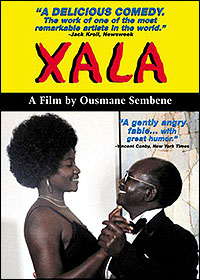
Xala (1975)

Today, June 11 2007, African filmmaker Ousmane Sembene passed away at the age of 84. I just remembered I've seen one of his films, Xala, a long time ago. I'm sketchy on details (cause it's been so long since I watched it) but it was a really good political satire comedy from what I remember. There was a character with impotence, which I believe was an allegory about the system and power. The end is very disgusting yet so hilarious and probably the one thing that you'll remember the most after watching this film. It's not the most challenging film, but the viewer does have to stay focused to really get into it. If you want a really strange African film though to see how complex African cinema could be, I'd suggest "Touki Bouki", which I didn't understand and was confused by. Well anyways, Xala is pretty accessible cause it is a comedy at the core but not too simple, that's a good thing. It's a nice start if you want to get into Sembene's films. This one is out on DVD in the US, although I see the DVD cost around $20 so try to rent or borrow it if you're low on cash.